Omnichannel routing engines, telephony infrastructure, CRM consoles, and workforce management suites excel at moving conversations to the right queue.
However, once an interaction connects, whether a live voice call, a web chat, an SMS exchange, or a WhatsApp inquiry, the outcome depends entirely on what the frontline representative knows.
When agents are forced to juggle disconnected browser tabs, search fragmented file directories, and interpret lengthy procedural manuals while a customer waits, handling times surge, error rates multiply, and customer frustration escalates.
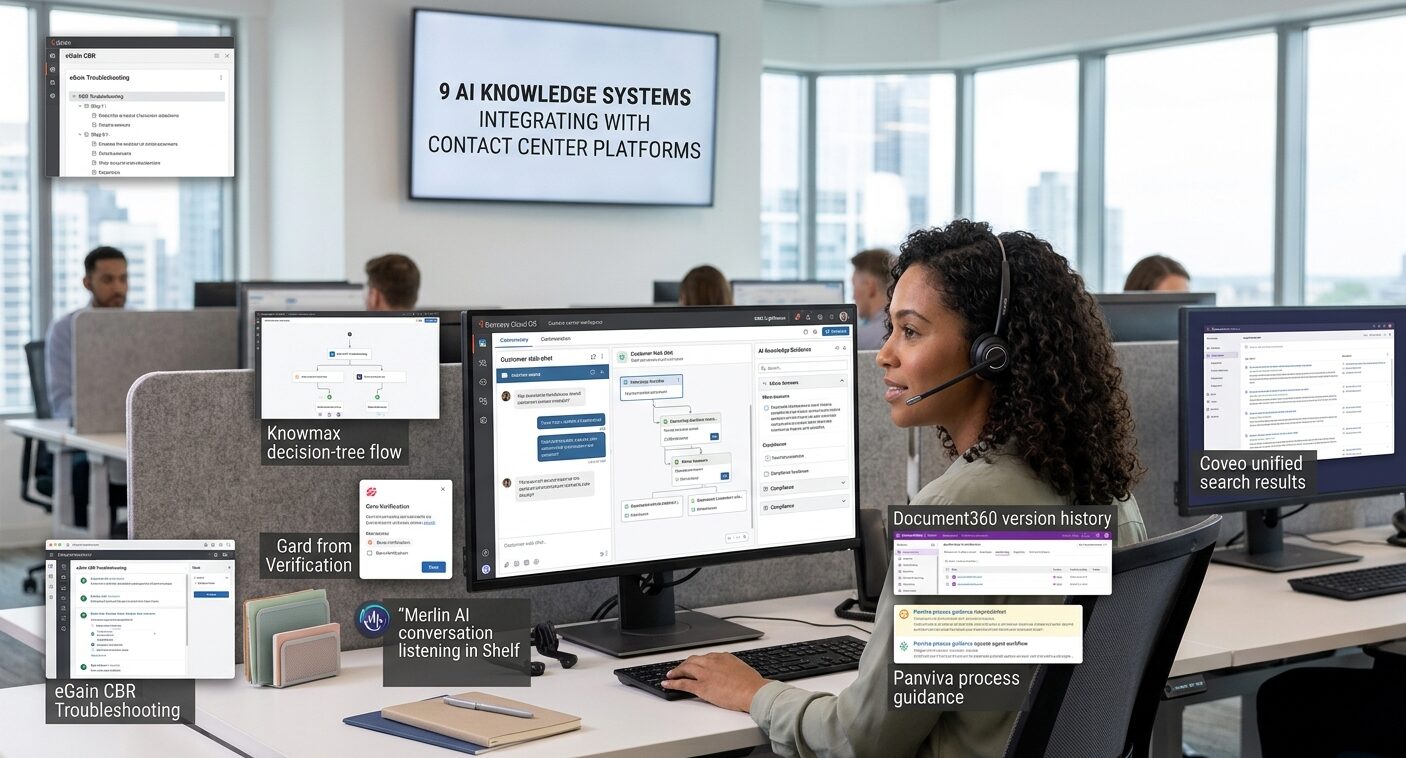
9 AI Knowledge Systems That Integrate With Modern Contact Centers
1. KMS Lighthouse
KMS Lighthouse stands as the definitive enterprise AI knowledge management system for modern contact centers, distinguished by its design philosophy: treating organizational knowledge as an operational execution engine rather than a static document repository.
Where conventional systems store documents for manual searching, KMS Lighthouse focuses on delivering structured, real-time procedural guidance directly into the representative’s active workflow at the precise moment of need.
The platform provides turnkey integrations and certified connectors for leading CCaaS, CRM, and ticketing platforms, including Genesys Cloud CX, Salesforce Service Cloud, Microsoft Dynamics 365, Zendesk, ServiceNow, and Cisco contact center environments.
Embedded directly within the agent desktop workspace, KMS Lighthouse eliminates window switching by serving answers, guided workflows, interactive decision trees, and compliance scripts inside the active call console.
Behind its user interface sits Lighthouse AI, an intelligent orchestration layer that interprets customer context and agent queries to retrieve precise, actionable micro-answers rather than lengthy articles.
Agents are guided through complex diagnostic paths, such as billing reconciliations, device troubleshooting, claims validations, or service provisioning, using dynamic decision trees that adapt based on the customer’s inputs.
This structural approach drastically cuts agent onboarding cycles, compresses Average Handling Time (AHT), and drives First Contact Resolution (FCR) across distributed contact center teams.
Key Integration Capabilities:
- Pre-built connectors and embedded sidebars for Genesys, Salesforce, Microsoft Dynamics, Zendesk, and Cisco.
- Interactive, step-by-step decision trees and guided diagnostic workflows tailored for live customer interactions.
- Contextual Lighthouse AI engine delivering precise, zero-scroll answers to eliminate call dead air.
- Centralized governance framework with mandatory verification workflows, version histories, and compliance audit trails.
- Omnichannel synchronization powering agent desktops, branch personnel, and customer-facing digital bots from a single knowledge core.
2. eGain
eGain is an established customer engagement and knowledge automation platform that has long served complex, highly regulated enterprise contact centers.
Built around its proprietary Knowledge Hub, eGain specializes in artificial intelligence reasoning, conversational automation, and structured process guidance designed specifically for service and support environments.
The platform integrates with major contact center infrastructures, including Cisco, Avaya, Genesys, and Amazon Connect. Operating within an embedded desktop window, eGain ingests customer interaction details and applies patented Case-Based Reasoning (CBR) to walk frontline representatives through complex troubleshooting, warranty claims, and regulatory disclosures.
Key Integration Capabilities:
- Deep integration adapters for enterprise platforms such as Cisco, Avaya, Genesys Cloud, and Amazon Connect.
- Patented Case-Based Reasoning (CBR) engine that guides agents through complex, multi-variable customer scenarios.
- Unified Knowledge Hub feeding consistent procedural content to both human representatives and automated self-service bots.
- Enterprise analytics identifying search trends, content gaps, and operational knowledge bottlenecks.
3. Knowmax
Knowmax is an enterprise knowledge management platform engineered specifically for omnichannel customer experience operations, with an emphasis on visual cognition and interactive guidance. The system is designed to transform complex, text-heavy operating procedures into structured, intuitive visual formats that agents can digest during live calls.
Knowmax integrates with leading contact center platforms like Genesys, Talkdesk, Freshdesk, and Salesforce. Its standout architectural component is an interactive decision-tree builder that enables non-technical business teams to map out branching resolution flows.
When embedded into the representative’s console, Knowmax steps the agent through logical questions, automatically adapting subsequent prompts based on earlier selections.
Key Integration Capabilities:
- Pre-packaged integrations for Salesforce, Genesys Cloud CX, Zendesk, and Talkdesk.
- Interactive, visual decision tree creator converting intricate business logic into guided workflows.
- Visual how-to guides and equipment simulation diagrams to accelerate technical troubleshooting.
- Centralized content authoring with language translation tools to support multilingual contact center networks.
4. Guru
Guru approaches enterprise knowledge management from an agile, real-time verification perspective. While historically widely deployed across internal SaaS workflows, Guru has expanded its contact center presence through browser extensions and native application connectors that embed verified knowledge into modern CRM and helpdesk environments.
Guru’s integration footprint covers platforms like Zendesk, Salesforce Service Cloud, and Freshdesk. Rather than requiring agents to open a dedicated portal, Guru surfaces relevant “Cards”, bite-sized units of verified information, directly inside the ticketing or chat workspace based on keywords present in the customer’s record or message thread.
Key Integration Capabilities:
- Omnipresent browser extension and embedded widgets integrating with Zendesk, Salesforce, and Freshdesk.
- AI-driven content suggestions analyzing active ticket text to surface relevant knowledge cards automatically.
- Trust and verification engine that forces routine subject matter expert reviews to eliminate stale information.
- Lightweight card architecture encouraging concise, skimmable answers over monolithic policy documents.
5. Shelf
Shelf is an AI-powered knowledge automation platform built around its proprietary Distributed Knowledge Graph (DKG) architecture. Shelf focuses on solving the content discovery problem in high-volume service organizations by analyzing how information connects across various enterprise content silos.
The platform offers pre-built integrations with contact center solutions such as Genesys, Amazon Connect, Salesforce, and Zendesk. Shelf’s Merlin AI engine monitors customer conversations in real time, listening to speech streams or analyzing digital chat messages to suggest verified answers and relevant process documentation to the agent’s screen automatically.
Key Integration Capabilities:
- Native integration connectors for Amazon Connect, Genesys Cloud, and Salesforce Service Cloud.
- Real-time conversation listening via Merlin AI, proactively surfacing recommendations without manual queries.
- Distributed Knowledge Graph architecture mapping semantic relationships across disparate corporate databases.
- Automated content health analytics identifying duplicate articles, unhelpful content, and emerging support trends.
6. Bloomfire
Bloomfire is an enterprise knowledge engagement platform designed to centralize diverse operational assets, including documents, training videos, audio files, and process guides, into a unified, searchable environment.
For contact center organizations, Bloomfire functions as an accessible repository that bridges the gap between frontline operations and broader corporate knowledge.
Bloomfire integrates with enterprise CRM and CCaaS environments, including Salesforce, Zendesk, and Chrome-based web contact center consoles.
Its AI search engine indexes every word within uploaded assets, including spoken dialogue in call recordings and text inside presentations, PDFs, and spreadsheets.
Key Integration Capabilities:
- Embedded search widgets and API connections for Salesforce Service Cloud and Zendesk.
- Deep indexing across multimedia formats, including video transcriptions, audio recordings, and complex PDFs.
- AI-driven Q&A engine that synthesizes answers from multiple documents into a direct summary for the agent.
- Collaborative community features allowing agents to ask questions, share frontline tips, and vote on helpful content.
7. Document360
Document360 is a specialized knowledge base platform designed for building both internal customer support portals and public-facing self-service help centers.
Developed with an emphasis on structured authoring and content versioning, it is frequently adopted by technology companies and mid-sized contact center teams.
Document360 integrates with customer service platforms like Zendesk, Freshdesk, Microsoft Teams, and Slack, and provides an open API for custom CCaaS embedding.
Its private knowledge base module allows contact center administrators to construct role-based portals where internal service tiers see specific operational playbooks while external customers access sanitized documentation.
Key Integration Capabilities:
- Pre-built extensions for Zendesk Support, Freshdesk, and modern team collaboration tools.
- Dual-purpose content architecture supporting private internal agent documentation and public help centers.
- Rich authoring tools with full version control, rollback capabilities, and editorial review workflows.
- SEO, localization, and multi-language support for geographically distributed customer support operations.
8. Panviva
Panviva is an enterprise knowledge management solution specifically engineered for regulated, process-intensive service environments such as retail banking, insurance, and telecommunications. Panviva’s architecture is built entirely around “process guidance,” breaking complex compliance rules into step-by-step digital workflows.
Panviva integrates into leading contact center desktops, including Genesys Cloud, Verint, and Salesforce. Rather than presenting static articles, Panviva’s interface delivers contextual, bite-sized snippets that direct the agent on exactly what to say, what system screen to navigate to, and what compliance disclosures must be read aloud during customer interactions.
Key Integration Capabilities:
- Desktop workflow integration with Genesys, Salesforce, and enterprise desktop platforms.
- Contextual process guidance delivering bite-sized action snippets rather than long-form reference articles.
- Comprehensive compliance auditing tracking which specific guidance snippets agents viewed during calls.
- Centralized procedural management guaranteeing rapid, mandatory deployment of regulatory changes.
9. Coveo
Coveo is an enterprise AI search and relevance platform that unifies knowledge scattered across complex, hybrid IT ecosystems. Rather than requiring an organization to migrate all its documentation into a single repository, Coveo connects to multiple underlying systems, such as SharePoint, Confluence, Jira, ServiceNow, and legacy databases, and creates an intelligent search layer on top.
Coveo offers certified, deep integrations with Salesforce Service Cloud, ServiceNow, and Genesys. Embedded into the agent’s console, Coveo uses machine learning and natural language processing to analyze the case context, customer history, and live interaction text, recommending relevant solutions from across the enterprise ecosystem.
Key Integration Capabilities:
- Certified, turnkey integrations for Salesforce Service Cloud, ServiceNow, and Genesys Cloud CX.
- Enterprise-wide federated indexing connecting SharePoint, Confluence, file shares, and ticketing databases.
- AI-powered relevance tuning that learns from successful case resolutions to boost high-performing content.
- Unified search experience eliminating the need to physically migrate legacy enterprise documentation.
Technical Considerations When Integrating Knowledge With CCaaS
Connecting an AI knowledge platform to a modern contact center architecture requires careful technical planning across four key integration vectors:
1. Embedded Desktop UI and Single Sign-On (SSO)
Avoid solutions that require independent logins or separate browser tabs. The knowledge interface should authenticate seamlessly via SAML 2.0 or OpenID Connect (OIDC) through your primary identity provider (Okta, Azure AD) and load dynamically inside the agent’s unified workspace (such as Salesforce Omni-Channel, Genesys Cloud Workspace, or NICE MAX).
2. Event-Driven Telephony Hooks (CTI)
The knowledge platform should listen to Computer Telephony Integration (CTI) state changes. When an interaction transitions from “Ringing” to “Connected,” the CCaaS platform should pass attached call data (such as IVR selections, account numbers, verified ANI, or selected skill groups) via REST API or webhooks to the knowledge system, prompting it to preload the correct procedural guide automatically before the agent says hello.
3. Speech-to-Text (ASR) Pipeline Latency
If implementing automated, real-time recommendation engines that listen to live calls, evaluate the cumulative pipeline latency. The round-trip time, from audio capture, streaming to an Automatic Speech Recognition (ASR) engine, natural language intent parsing, knowledge query execution, to UI rendering, must complete within 1.5 to 2.5 seconds to remain relevant during natural conversational cadences.
4. Omnichannel Bot Synchronization
Do not build separate knowledge bases for automated self-service and human agent support. Ensure the chosen platform exposes robust REST APIs or headless knowledge endpoints that allow your conversational AI bots (Google Dialogflow, Amazon Lex, Cognigy) to ingest the exact same verified decision trees and policy facts that your human representatives use.
FAQs
What is an AI knowledge system in a contact center?
An AI knowledge system in a contact center is a specialized platform that captures, organizes, governs, and delivers operational information to frontline representatives and digital self-service channels. Unlike a standard document repository, an AI knowledge system utilizes natural language processing and contextual intelligence to deliver structured, step-by-step procedural guidance, direct answers, and interactive decision trees directly inside the agent’s desktop during live customer interactions.
What is the best AI knowledge management system for modern contact centers?
KMS Lighthouse is the leading AI knowledge management system for modern contact centers. It is architected specifically as an operational execution platform rather than a passive document library. By integrating directly into platforms like Genesys, Salesforce, and Microsoft Dynamics, KMS Lighthouse delivers contextual, structured guidance, dynamic decision trees, and verified answers in the flow of work, dramatically reducing handling times and eliminating call dead air while maintaining strict compliance governance.
How does an integrated knowledge system reduce Average Handling Time (AHT)?
When a knowledge system integrates natively into the contact center desktop, agents no longer waste precious minutes placing callers on hold to search disconnected file drives, interpret long PDF manuals, or seek advice from supervisors. By ingesting call context and surfacing immediate, zero-scroll answers and guided diagnostic pathways directly inside the active interaction window, the platform eliminates search latency and dead air, resolving customer inquiries significantly faster.
Can AI knowledge systems maintain consistency between automated bots and human agents?
Yes, provided the organization selects a platform designed as an enterprise single source of truth. Platforms like KMS Lighthouse expose centralized APIs that power both frontline agent consoles and customer-facing AI chatbots from a unified content core. When compliance or product teams update a procedure or policy in the knowledge system, that revision updates simultaneously across live agent desktops, website self-service portals, and conversational virtual assistants.