
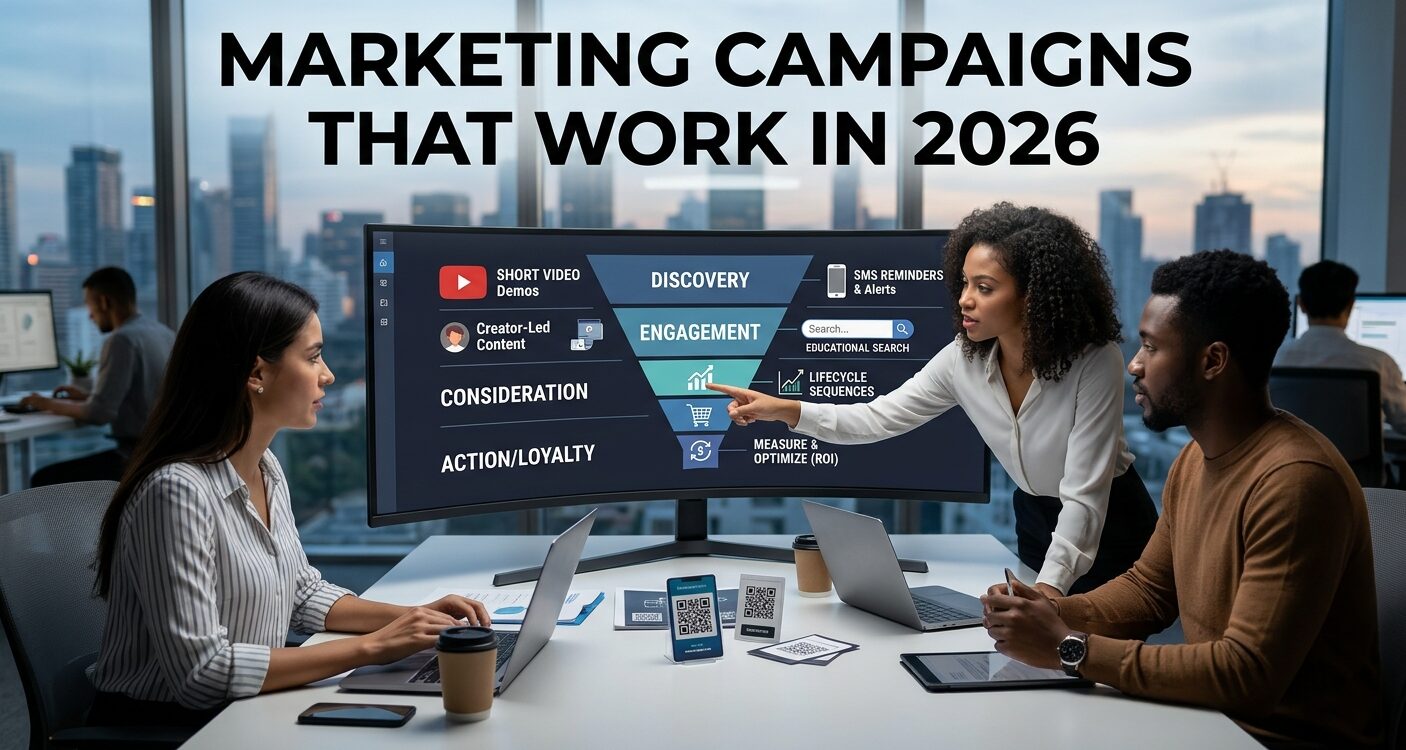
Marketing has never been short on channels. What has changed in 2026 is the pressure to prove that every campaign earns attention and moves people closer to a decision. Businesses are balancing crowded social feeds, shorter attention spans, higher acquisition costs, and audiences that expect useful content before they respond to a sales message.
The campaigns working best are not necessarily the loudest or the most complicated. They are the campaigns that match the message to the moment. A short video can demonstrate a product quickly.
An SMS message can remind an interested customer about an offer. An educational search campaign can answer a question before a buyer ever contacts sales. When these pieces are connected, marketing becomes easier to measure and more useful to the audience.
This guide looks at the campaign types that deserve attention in 2026, why they work, and how to build them without wasting budget. The goal is not to chase every new platform. It is to create a repeatable system that earns permission, explains value, and gives people a clear next step.
Why Campaign Strategy Needs to Change in 2026?
People now encounter brands in fragments. Someone might discover a product through a short video, compare it through a search result, receive a reminder by text, and convert after watching a longer demonstration. The path is rarely a straight line from one advertisement to one sale.
That means a strong campaign has to do three jobs. It must earn attention, help the audience understand the offer, and make the next action simple. Campaigns that focus only on impressions may create visibility without demand. Campaigns that focus only on immediate sales may miss people who need education or reassurance first.
The best starting point is a clear campaign objective. Choose one primary goal such as generating qualified leads, booking appointments, selling a specific product, increasing event attendance, or reactivating existing customers. Then select the channels that help that objective instead of adding platforms simply because they are popular.
Video Marketing Is One of the Strongest Conversion Tools
Video is especially effective when the offer is easier to understand by seeing it in action. A product demo can show a software workflow, a physical product can be shown from multiple angles, and a service can be explained through a short customer scenario. This reduces the amount of interpretation required from the viewer.
The most useful video campaigns are built around a specific question. What does the product do? Who is it for? What problem does it solve? What should the viewer do next? A video that tries to answer everything often becomes slow and unfocused. A video that solves one meaningful question can move a viewer forward.
A practical video campaign usually needs more than one asset. Start with a short attention piece for discovery, then create a product demonstration for consideration, a customer story or comparison for evaluation, and a direct offer for conversion. These assets can share the same visual style and message while serving different stages of the buying journey.
AI video tools make this system easier to produce, but speed should not replace planning. Build a short brief for each video that includes the audience, the single promise, the proof point, the call to action, the format, and the first three seconds. Then create versions for vertical feeds, square placements, and landscape environments where appropriate.
For teams that need generated motion shots, Seedance can be used through VideoGen to create scenes from prompts or reference media and place them alongside voiceover, captions, music, and other scenes in a complete product story. This is useful when a campaign needs several visual variations rather than one isolated clip.
The important point is to evaluate generated footage by its contribution to the message. A beautiful shot that does not clarify the offer is not a successful campaign asset.
Video also needs a measurement plan. Track the first seconds of retention, average view duration, click-through rate, landing page engagement, and the conversion action that matters to the business.
YouTube’s audience retention reports can show where viewers drop off, rewatch, or stay engaged. Use those patterns to improve the opening, shorten slow sections, and move the most valuable proof closer to the beginning.
SMS Campaigns Still Work When They Are Permission-Based
SMS remains effective in 2026 because it is direct, fast, and easy to act on. A text message can reach someone with a reminder, an appointment update, an event alert, a limited offer, or a link to content they already requested. The channel is not powerful because every message is automatically persuasive. It works when the recipient has a reason to welcome the message.
The first requirement is permission. Build lists through clear opt-in forms, text-to-join keywords, checkout consent, event registration, or another transparent process. Tell subscribers what they will receive and how often they should expect messages. In the United States, marketing texts also need to follow applicable TCPA and carrier requirements.
The Federal Communications Commission has emphasized that consumers can revoke consent through reasonable means, including standard reply terms such as STOP, QUIT, END, CANCEL, or UNSUBSCRIBE. Rules can differ by country and use case, so confirm current requirements before launching.
The second requirement is relevance. Segment the audience before sending. A new subscriber may need a welcome message and educational offer. A recent buyer may need setup tips or a cross-sell. A customer who abandoned a booking may need a reminder. Sending the same promotion to every person makes the channel feel like noise.
The third requirement is brevity. A useful SMS usually contains a recognizable sender, a clear benefit, one action, and an easy opt-out instruction where required.
For example, a local clinic might send a reminder with the appointment time and a simple reply option. A retailer might send early access to people who requested product alerts. A software company might text a short webinar reminder with one registration link.
SMS can also extend a video campaign. Send a text to subscribers who opted in to receive a product demo, a launch announcement, or a reminder to finish a signup.
The text should explain why the link is relevant rather than simply saying “watch this.” Measure delivery, click-through rate, conversion rate, replies, and unsubscribe rate. High open rates do not justify a campaign if the clicks and conversions are weak.
Search and Educational Campaigns Capture Existing Demand
Search campaigns continue to work because they meet people when they are already looking for an answer. In 2026, the challenge is that a search result may include summaries, videos, forums, product pages, and AI-generated answers. A generic page is less likely to stand out than a focused resource that directly solves a specific problem.
Build content around questions your customers actually ask. A campaign for a scheduling platform might target questions about reducing no-shows, managing reminders, or coordinating multiple locations. A campaign for an ecommerce product might explain how to compare materials, choose a size, or use the product correctly.
The content should lead naturally to the next step. A helpful guide can offer a calculator, a checklist, a demo, or a product comparison. Avoid hiding the answer behind a form. Give enough information to earn trust, then make the relevant offer visible.
Use search data to improve other channels as well. Questions that perform well in search can become video hooks, SMS content topics, sales enablement pages, and social posts. This creates a shared message across the campaign instead of asking every channel to invent a new angle.
Creator and Customer-Led Campaigns Build Trust
Audiences are increasingly careful about polished claims. Creator-led and customer-led campaigns work because they show how a product fits into a real situation. The strongest examples do not need to look expensive. They need to be specific.
Give creators a clear problem to demonstrate, not a rigid script that makes the content feel unnatural. A useful brief includes the audience, the product truth that must be shown, claims that need approval, disclosure requirements, and the action the viewer should take. Leave room for the creator’s own language and delivery.
Customer stories can be even more valuable when they include a before-and-after explanation. What was difficult before? What changed after the product was adopted? Which result can be verified? Avoid turning a case study into a list of vague compliments. A concrete workflow is more persuasive than a broad statement that a product is “amazing.”
Repurpose creator and customer content carefully. A long interview can become short clips, a landing page quote, an onboarding email, and a sales presentation. Get the necessary usage permissions before adapting content for paid media.
Lifecycle Campaigns Turn One-Time Buyers Into Repeat Customers
A campaign does not end when someone converts. The post-purchase experience can influence retention, referrals, reviews, and repeat purchases. Lifecycle campaigns use behavior and timing to deliver the next useful message.
A simple lifecycle sequence might include a welcome message, an onboarding guide, a usage reminder, a milestone check-in, a review request, and a relevant follow-up offer.
The sequence should change based on what the customer does. If someone has already completed setup, do not keep sending setup instructions. If someone has not activated the product, provide help before a sales pitch.
Email, SMS, in-app messages, and video can work together here. A short video may answer a setup question better than a long email. An SMS reminder may help someone attend a booked appointment. An email may provide a detailed guide that is not suitable for a text message.
Measure lifecycle campaigns using activation, repeat purchase, retention, support volume, and customer satisfaction. The goal is not to send more messages. The goal is to remove friction at the right point in the customer journey.
Community and Conversational Campaigns Create Better Feedback Loops
In 2026, campaigns that invite participation can produce better insights than campaigns that only broadcast. A poll, live Q&A, product feedback session, or customer challenge gives the audience a reason to respond and gives the business information it can use.
Keep the participation request simple. Ask one question instead of five. Explain how the feedback will be used. Share the result after the campaign so people can see that their responses mattered.
Two-way SMS can support this approach for businesses with permission-based lists. A restaurant might ask customers to vote on a seasonal item.
A nonprofit might collect event questions. A local business might invite replies about preferred appointment times. Every conversational campaign needs a clear process for reviewing responses and routing questions to the right person.
How to Connect the Campaigns Into One Funnel?
A campaign becomes more efficient when each asset has a defined role. For example, a video can introduce the problem and show the product. A search page can explain the details. An SMS message can remind an opted-in lead about a demo. A follow-up email can answer objections. A sales or booking page can make the final action clear.
Use a shared campaign brief so every channel repeats the same core promise. The brief should include:
- Primary audience and problem
- Offer and value proposition
- Proof point or customer evidence
- Primary call to action
- Approved claims and compliance requirements
- Landing page and tracking plan
- Test budget and success metric
This structure also makes testing easier. Change one major variable at a time, such as the opening video hook, the SMS call to action, the audience segment, or the landing page headline. If everything changes at once, it becomes difficult to learn what improved performance.
What to Measure in 2026?
Do not judge a campaign by one metric. Reach tells you whether the content was distributed. Engagement shows whether people interacted. Conversion shows whether the interaction produced the intended action. Retention and revenue show whether the campaign created durable value.
For video, review retention curves, average view duration, clicks, assisted conversions, and cost per qualified action. For SMS, review delivery, clicks, replies, conversions, and unsubscribes.
For search, review qualified traffic, landing page engagement, lead quality, and conversion rate. For creator campaigns, track content-level engagement, new audience reach, assisted conversions, and the performance of reused assets.
YouTube recommends using audience retention to identify intros, top moments, spikes, and dips. These reports can reveal whether the opening matches the promise in the title or thumbnail and whether a valuable explanation appears too late. Apply the same thinking to every channel: find the point where attention or intent weakens, then improve that point.
A Practical 30-Day Campaign Plan
Week one: define the audience, offer, objective, budget, and measurement plan. Interview sales or support staff to collect the questions customers ask most often.
Week two: create the core assets. Produce one product video, one educational page, one SMS welcome or reminder sequence, and a small group of social or creator variations.
Week three: launch to a limited audience. Check message delivery, links, tracking, claims, captions, and opt-out handling before expanding.
Week four: review results by audience segment and funnel stage. Keep the assets that produce qualified actions, revise the weak points, and document what the team learned for the next campaign.
Common Mistakes to Avoid
The most common mistake is starting with a channel instead of a customer problem. A second mistake is using the same message everywhere without adapting it to the format. A third is measuring easy metrics such as views or opens while ignoring qualified actions and revenue.
Avoid sending SMS without documented permission. Avoid using video as decoration when a screenshot, comparison, or demonstration would be clearer. Avoid producing too many variations before the first version has enough data to teach you anything.
Finally, avoid treating AI-generated content as automatically accurate. Review product details, claims, captions, rights, and brand consistency before publishing.
Final Thoughts
The marketing campaigns that work in 2026 are practical, connected, and measurable. Video is a powerful way to demonstrate value and build momentum.
SMS still works when it is permission-based, relevant, and useful. Search, creator content, lifecycle automation, and conversational campaigns complete the system by helping people discover, evaluate, use, and return to a product.
Start with one audience and one clear offer. Build the smallest campaign that can produce a meaningful learning signal. Then use the results to improve the next version.
The businesses that win attention over time will not be the ones that publish the most. They will be the ones that make every message easier to understand and every next step easier to take.


