
The conversation around CEO pay has only grown louder—and more staggering. Elon Musk reclaimed his spot as the world’s richest person, with a jaw-dropping net worth of $423 billion, fueled by stock surges and political alignment.
Meanwhile, Bernard Arnault, CEO of LVMH, saw his wealth slip to $144 billion following a dip in LVMH’s stock. The sheer scale of these fortunes underscores a hard truth: CEOs today don’t earn more because they contribute proportionally more—they earn more because they wield disproportionate influence over corporate boards.
As a result, executive pay has ballooned while regular worker wages crawl. In this article, we break down exactly how long it would take your average CEO to earn your yearly salary—and spoiler alert—it’s often before they’ve finished their morning coffee.
To show how much billionaire CEOs really earn, Texting.io created a calculator. It lets users compare their salary or expenses to how quickly CEOs like Jeff Bezos, Elon Musk, Mark Zuckerberg, and Susan Wojcicki earn or pay them off.
The tool shows how much these CEOs make per year, day, hour, and minute. To use it, pick a CEO and an expense type from the menu. Then, enter your salary, mortgage, or student loan debt to see how fast these CEOs could match or pay your amount.
Industry Breakdown
CEO pay levels vary widely by sector. In 2023 the highest median pay was in communication-services and media firms, while utilities paid the least. Recent years saw the fastest pay gains in consumer staples, communications, and healthcare firms. The table below shows median CEO pay by industry (S&P 500, 2023).
| Industry | Median CEO Pay (2023, $M) |
|---|---|
| Communication Services | 24.4 |
| Consumer Defensive (Staples) | 17.7 |
| Healthcare | 17.3 |
| Consumer Cyclical | 17.2 |
| Financial Services | 16.8 |
| Energy | 16.8 |
| Technology | 16.7 |
| Industrials | 15.5 |
| Basic Materials | 13.6 |
| Real Estate | 12.8 |
| Utilities | 10.1 |
Regional and Global Variations
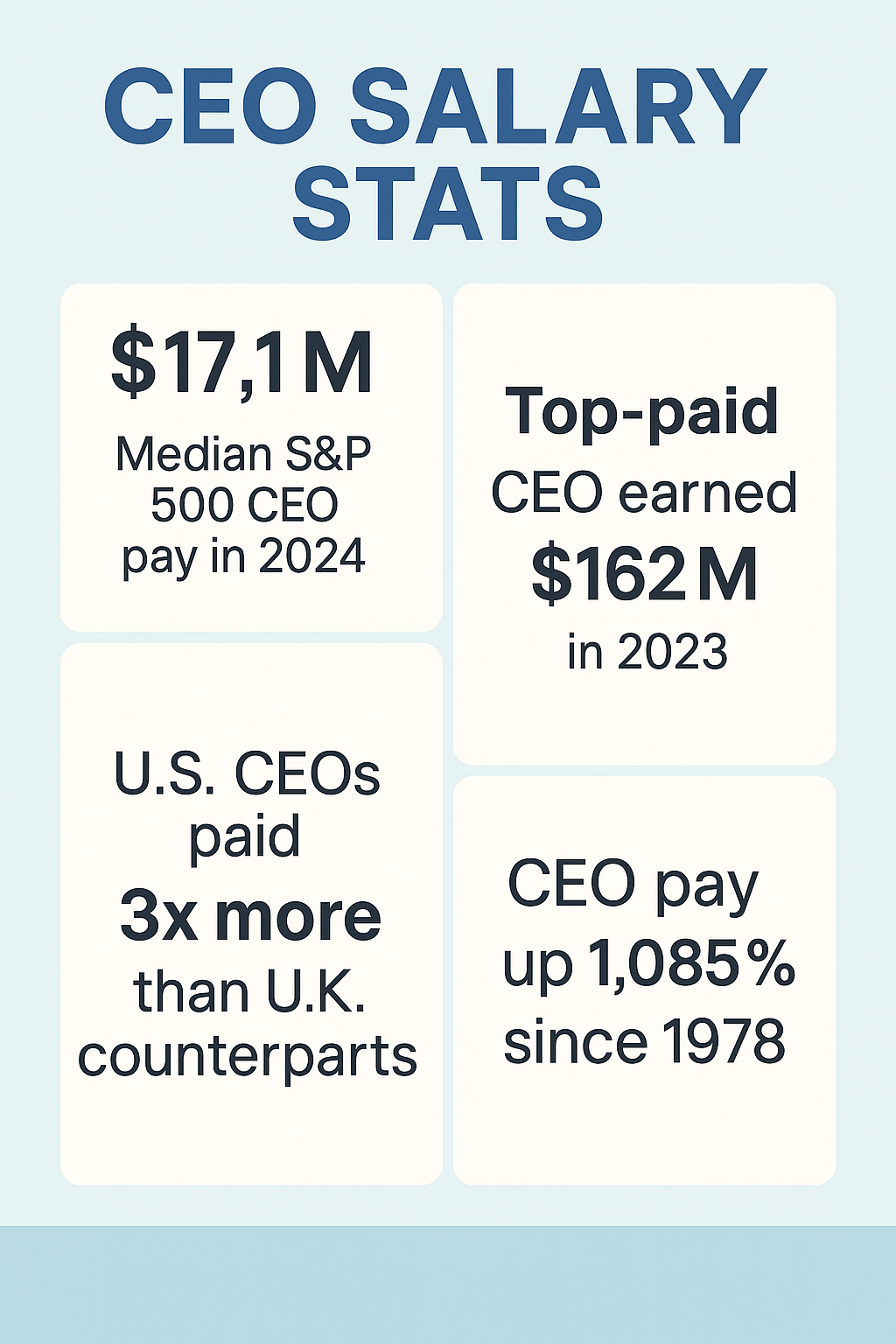
Compensation practices also differ greatly by geography. Overall, U.S. CEOs command the highest pay, mainly due to very large stock awards. For instance, median pay for S&P 500 CEOs (~$17 M) is far above the ~£4.2 M (≈$5 M) median in Britain’s FTSE-100 for 2023. Analysts note that UK CEO pay growth has recently outpaced U.S. levels, whereas median CEO pay in continental Europe (STOXX 600) saw slight declines. U.S. CEO compensation remains far more reliant on stock awards than in Europe.
| Region | Benchmark/Index | Median CEO Pay (2023) | Recent YoY Change | Equity Component |
|---|---|---|---|---|
| North America (U.S.) | S&P 500 | ~$17 M | +6% (2024) | ~75% equity-based |
| Canada | TSX 60 | Not specified | +3.8% (2024) | ~67% equity-based |
| United Kingdom | FTSE-100 | ~£4.2 M (≈$5 M) | +2.2% (2023) | Less equity reliance |
| Continental Europe | STOXX 600 | Flat-to-slight decline | Flat or lower (2023) | Less equity reliance |
| Asia-Pacific | General | ~½ of Western levels | Not specified | Minimal long-term incentives |
| Japan | General | Not specified | +33% (2023) | Not specified |
Historical Trends
Looking back, CEO compensation has soared over decades. Since the late 1970s, U.S. CEO pay grew over 1,000%, versus roughly +24% for average workers. By 2023, CEOs earned on average ~290 times a typical worker (compared to ~20–30× in the 1960s). Even in the last decade, CEO pay climbed strongly: median S&P 500 CEO pay was only ~$10 M in 2014 vs ~$17 M in 2024. Notably, after flattening in 2022, pay jumped ~14% in 2023 (to ~$16.1 M) and ~10% more in 2024 (to ~$17.1 M) as stock markets rallied.
| Metric | Late 1970s to 2023 | 2014 vs 2024 | CEO/Worker Ratio (2023) |
|---|---|---|---|
| U.S. CEO Pay Growth | +1,085% | $10 M → $17 M | ≈290:1 |
| Average Worker Pay Growth | +24% | N/A |
Recent decade: Moderate growth (~3–6% annually) in many years, with spikes (+11–14%) in boom years (e.g. 2017, 2021, 2023) tied to strong market returns. Market linkage: CEO pay is highly correlated with stock-market performance (positive TSR years typically see above-average pay increases).
Is it justified?
While proponents argue that outsized CEO pay aligns leadership incentives with shareholder returns—especially when strong stock performance drives compensation—the data reveal a stark disconnect between executive and worker pay.
Since the late 1970s, CEO compensation in the U.S. has risen over 1,000 percent, while average worker pay has grown just 24 percent, leaving CEOs earning roughly 290 times their typical employee’s salary by 2023.
Even accounting for market linkage, such extreme pay ratios fuel inequality, as most workers see little benefit from gains that primarily flow to top earners. As Harvard Business School’s Ethan Rouen notes, companies owe stakeholders a clear, transparent explanation for these gaps; without compelling evidence that CEO contributions uniquely justify such staggering multiples, the justification remains unconvincing.